10 Grocery Habits Costing You $300+ a Month (My $75/Week Grocery List For 2)
Scarcity 2 Sovereignty · 12 min read
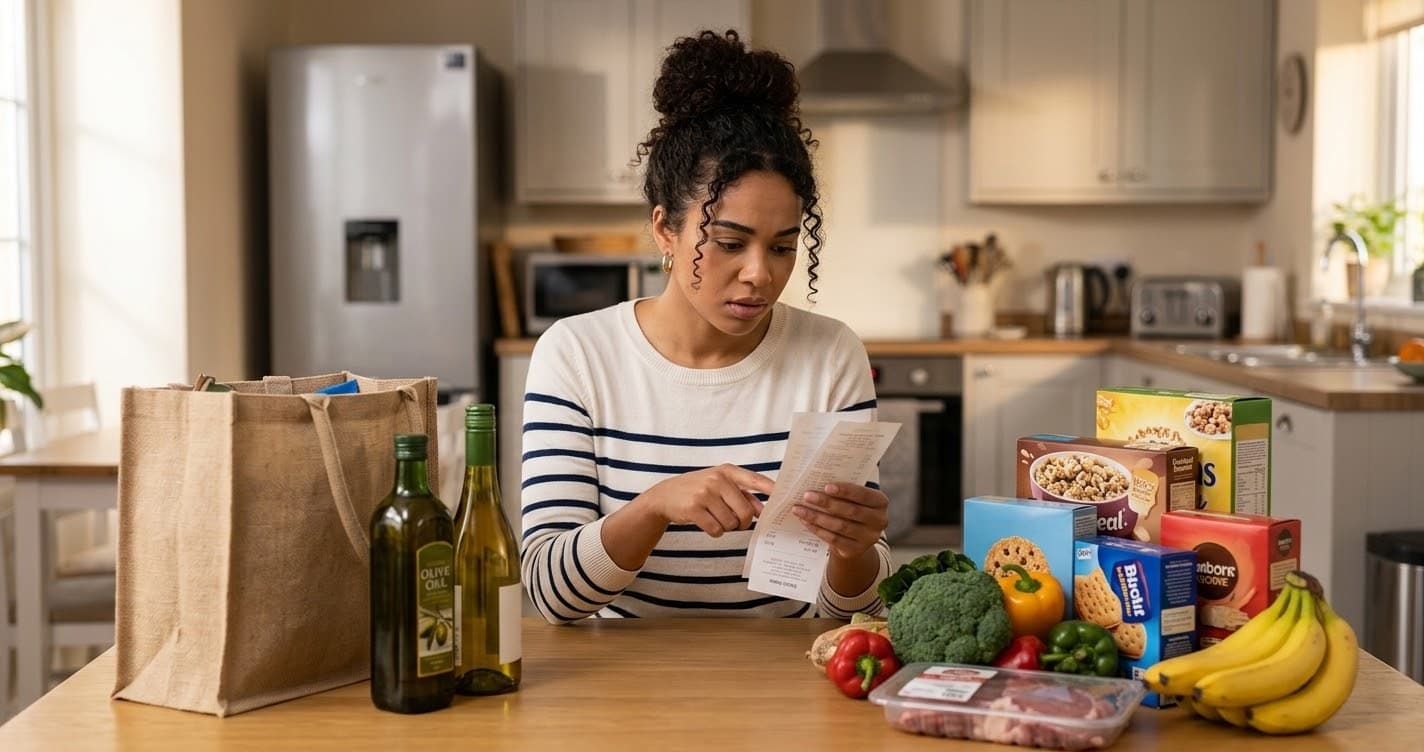
I was spending $865 a month for two people. That was when I had my mom over at my place to recuperate, and I remember having insomnia one certain night, then I went to grab some milk in the kitchen. I sat there drinking it, lazily staring at the milk jug, when the bright lettered price at the corner of the label caught my eye.
I'd been uncomfortable for the past two months and a week over the upsurge in my grocery expenses, but I'd been busy on a book project and didn't have much time to spare. Immediately, I thought, "let me just use this sleeplessness to finally get some of the things I've been postponing done."
So I sat at my kitchen table with ten weeks of receipts spread out in front of me, checking some against my phone apps, genuinely confused about where it was all going.
We weren't eating out, since my mom prefers homemade food. We weren't buying anything fancy. It was just... groceries, week after week, quietly adding up to a number that didn't match what was actually in our fridge.
So I did something most people never bother doing. I tracked every single receipt for two full months, line by line, and matched it against what we'd actually eaten versus what had gone bad, gone uneaten, or gotten bought on autopilot without me really deciding to buy it.
What I expected to find was probably one big recurring mistake, but surprisingly, it turned out to be a handful of small, boring, completely normal habits, the kind almost every American household has without realizing it. Some I detected straight from the receipts. Others I only figured out after a lot of reflection.
It was such a revelation that I documented everything and discussed it with my mom, who wasn't as surprised as I was. She'd experienced it in her younger years too, just in a slightly different form, since there weren't nearly as many digital apps back then as we have today.
By the time I list them out below with a detailed explanation, I think you're going to see yourself in more than a few.
1. Letting the grocery delivery app set your price, not the store
What it costs me: roughly $35/month in my own tracking.
Statistics to back my claim: A December 2025 investigation by Consumer Reports and Groundwork Collaborative found that Instacart's AI pricing system shows different prices to different shoppers for the exact same item, in the exact same store, at the exact same time, by as much as 23%. Scaled across a typical household's annual grocery spend, that pattern alone adds an estimated $1,200 a year for a family of four. Isn't that insanely surprising, that we're being subtly fleeced?
Important update: Instacart ended the item price tests in December 2025 and said from now on if two families shop for the same items at the same time from the same store location on Instacart they see the same prices.
Why we all do it: convenience wins, especially on a busy week, and the app's total doesn't exactly scream "you're being charged a different price than your neighbor" until you've already checked out.
What to do instead: Instacart has rightfully made a good move to be fair to all. Nevertheless, when you can, shop in person for your biggest trip of the month, and reserve delivery for genuinely urgent, small top-up orders where the markup on two or three items barely matters.
2. Letting food quietly die in the back of the fridge
What it costs me: about $85/month, based on tracking what I actually threw out.
Statistics to back my claim: This isn't a guess. The EPA updated its own national estimate in April 2025, and it nearly doubled the old number. The average household of four now loses an estimated $2,913 a year to food that's bought and never eaten, up from the $1,500 figure that's been quoted for over a decade.
Why we all do it: we buy with good intentions, a week's worth of spinach, a bag of berries, and life happens. The spinach wilts before the plan does, and it just ends in the trash can.
What to do instead: buy perishables in smaller, more frequent amounts rather than one big stock-up, and do a five-minute "use it or lose it" check of your fridge every few days before it's too late. I started doing this and it really worked.
3. Paying extra for someone else to hold the knife
What it costs me: around $25/month. Pre-cut produce carries an average 40% markup, and on specific items it's far worse. I was going for these because of my busy schedule, and I didn't want to stress my mom, who'd only come over to recuperate.
Statistics to back my claim: pre-cut onions have been documented running 192% to 392% higher than whole, with kale and green beans not far behind.
Why we all do it: five extra minutes with a cutting board feels like a lot when you're exhausted after work, or when you're working on a project that requires spending less time in the kitchen.
What to do instead: buy whole and cut it yourself during those free minutes or hours you have, or lean on frozen produce instead, which we'll get to in a minute, since it flips this entire problem on its head.
4. Paying the "healthy halo" tax without checking if it's worth it
What it costs me: about $30/month. Organic produce runs roughly 50% more than conventional on average, and that gap widens to as much as 100% more for organic dairy and meat specifically.
Why we all do it: "organic" feels like the responsible choice, and nobody wants to feel like they're cutting corners on what their family eats.
What to do instead: be selective rather than blanket-buying organic. Produce with a thick peel you remove anyway, bananas, avocados, oranges, carries far less pesticide exposure difference than something you eat skin-on.
Disclaimer: it's fine to stick with the "healthy halo" choice if you're strictly following a healthy diet or have been advised by a dietitian or your doctor.
5. Grabbing the deli hot bar on a tired night
What it costs me: roughly $35/month.
Statistics to back my claim: Prepared and deli foods, rotisserie meats, pre-made sides, carry an average markup of 60% to 78%, according to 2021 convenience industry data.
Why we all do it: it's dinner solved in ninety seconds, and on a genuinely hard day, that's worth something.
What to do instead: keep one or two "emergency dinner" staples on hand at home specifically for the nights you'd otherwise reach for the hot bar, something that takes less than ten minutes and costs a fraction of the price. It should be something healthy, not junk food.
6. Wandering into the bakery "just to look"
What it costs me: about $20/month.
Statistics to back my claim: In-store bakery items have been documented with markups as high as 300%, among the steepest in the entire store.
Why we all do it: fresh bread smells incredible, and it's genuinely hard to walk past it with an empty stomach and an empty cart. Lol.
What to do instead: route your cart around the bakery section on routine trips, and save it as an intentional, occasional treat rather than a weekly default. My mom gave this advice, and it actually works.
7. Buying the name brand out of habit, not preference
This is very common and often passed down through generations. There are some brand products I buy simply because I grew up with them, loved them, and it just felt natural to keep buying them as an adult.
What it costs me: roughly $25/month.
Statistics to back my claim: Name-brand cereal runs about 40% more than the store-brand version sitting right beside it, and name-brand spices can run closer to 100% more, for a product that's frequently made in the exact same facility.
Why we all do it: brand loyalty is sticky, and a lot of us never actually run the side-by-side comparison to check if the taste difference is real or just familiar packaging.
What to do instead: pick three or four items you buy constantly and do a genuine taste test against the store brand. You'll likely find at least half of them are indistinguishable.
8. Trusting whatever's at eye level
What it costs me: about $20/month.
Statistics to back my claim: This is a documented, intentional retail tactic. Stores place their highest-margin products at eye level on purpose, while cheaper alternatives, often identical in quality, get pushed to the top and bottom shelves.
Why we all do it: it's not laziness, it's design. You're not supposed to notice you're being steered. By the way, older people are the most vulnerable group here, since they often find it stressful having to bend or stand on their toes to pick products. The same applies to those with bad eyesight. It's easier to just pick whatever's within reach and move on.
What to do instead: make it a habit to physically look up and down before grabbing the first thing you see at eye level, especially in the cereal, pasta sauce, and spice aisles. If you fall into this vulnerable group, you can get someone to go shopping with you so they can assist with the picking and checking.
9. Shopping without a list and "seeing what looks good"
What it costs me: about $30/month. This is by far the most honest and uncomfortable number on this list for me personally. Walking in without a plan turns a grocery trip into a series of small, unplanned decisions, and those decisions add up fast.
Why we all do it: a list feels restrictive, and "staying flexible" feels like freedom, right up until you're home and realize you bought four things you already had and forgot the one thing you actually needed.
What to do instead: build your list directly from what's already in your fridge and pantry, not from what sounds good in the moment. It turns shopping into a targeted mission instead of a browsing session.
10. Grocery shopping on an empty stomach
What it costs me: about $20/month. This one's well-documented common sense that almost everyone knows and almost everyone ignores anyway, which is exactly the kind of habit this list is built around. Hunger doesn't just make food look better. It makes your brain weigh short-term cravings more heavily than your actual plan.
Why we all do it: life is scheduled tight, and "grab a snack before shopping" rarely makes the priority list when you're already running late.
What to do instead: eat something, anything, even a handful of nuts in the car, before you walk through those doors. It's the cheapest five minutes you'll ever spend.
The full picture, at a glance
Here's a simple summary of the habits above. Write them out in a notebook, or even on a sticky note to paste on your fridge or somewhere around the kitchen where you can easily see it whenever you're going grocery shopping.
| Habit | Monthly Cost | Swap Instead |
|---|---|---|
| Delivery app markup | $35 | Shop in person for big trips |
| Food waste | $85 | Buy smaller, more often |
| Pre-cut produce | $25 | Cut it yourself, or buy frozen |
| "Healthy halo" organic items | $30 | Be selective, not blanket organic |
| Deli hot bar | $35 | Keep an emergency dinner staple |
| Bakery wandering | $20 | Route around it, make it a treat |
| Name-brand habit | $25 | Taste-test the store brand |
| Eye-level trap | $20 | Look up and down the shelf |
| Shopping with no list | $30 | List from your own fridge, not your mood |
| Shopping hungry | $20 | Eat something first, always |
| Total | $325 |
The 3 habits I kept, because they actually save money
Not everything on a grocery receipt is a trap. After reflecting on it, these three stayed in my cart, deliberately, because the math actually favors them.
1. Rotisserie chicken. This one's a genuine insider fact. At several major chains, including the famous $4.99 Costco example, rotisserie chicken is widely reported to be sold near or at cost, specifically to get you in the door. It's one of the rare prepared foods that doesn't carry the usual convenience markup.
2. Frozen produce over fresh. Frozen vegetables and fruit run roughly 30% cheaper than fresh, and because they're flash-frozen at peak ripeness, the nutritional difference is minimal to none. This is also the direct fix for habit #3 above.
3. Store brand, consistently. This isn't a compromise. Generic and store-brand products are frequently manufactured in the exact same facilities as their name-brand counterparts, a well-documented finding from both the FTC and Consumer Reports, just without the marketing budget baked into the price.
My $75 weekly grocery list for two people
This is the actual framework I rebuilt my own shopping around, modeled on how frugal-living households typically structure a lean but genuinely nutritious week. Your exact total will shift based on your region, your store, and current prices, this isn't a precise, universal number, it's a realistic starting structure.
- Eggs (1 dozen)
- Chicken thighs (family pack, portioned and frozen)
- Rice (large bag, lasts multiple weeks)
- Dried or canned beans (a few varieties)
- Frozen mixed vegetables (2-3 bags)
- Bananas and one other seasonal fruit
- Oats
- Canned tomatoes (for sauces and soups)
- Pasta
- Peanut butter
- Bread
- Milk or a milk alternative
- Onions, garlic, and one fresh vegetable that stores well (carrots or cabbage)
Building and sticking to a list like this gets significantly easier with an actual structure to write it into. If you haven't already, the Free Monthly Budget Planner gives you a simple way to track exactly this kind of category spending so you're not just hoping the $75 holds, you're actually watching it.
Where this actually leads
None of these ten habits are dramatic on their own. That's exactly why they survive. A 40% markup on one bag of onions doesn't register. Ten small leaks running quietly every single week absolutely do, and $325 a month is $3,900 a year, money that could be going toward the goals in 10 Personal Finance Goals to Crush This Year instead of toward a bag of pre-cut kale.
Next: 6 Simple Ways to Save Money on Gas Without Changing Your Routine
The statistics cited above are drawn from publicly available studies and investigations, including EPA, Consumer Reports, Groundwork Collaborative, and industry markup research, current as of the time of writing. The specific monthly dollar figures reflect one household's personal tracking and are illustrative, not a guaranteed outcome, since actual costs vary by region, store, and individual shopping habits.